
About saigas
Population history & threats
From millions, to near collapse, to a fragile recovery — and the pressures that remain.
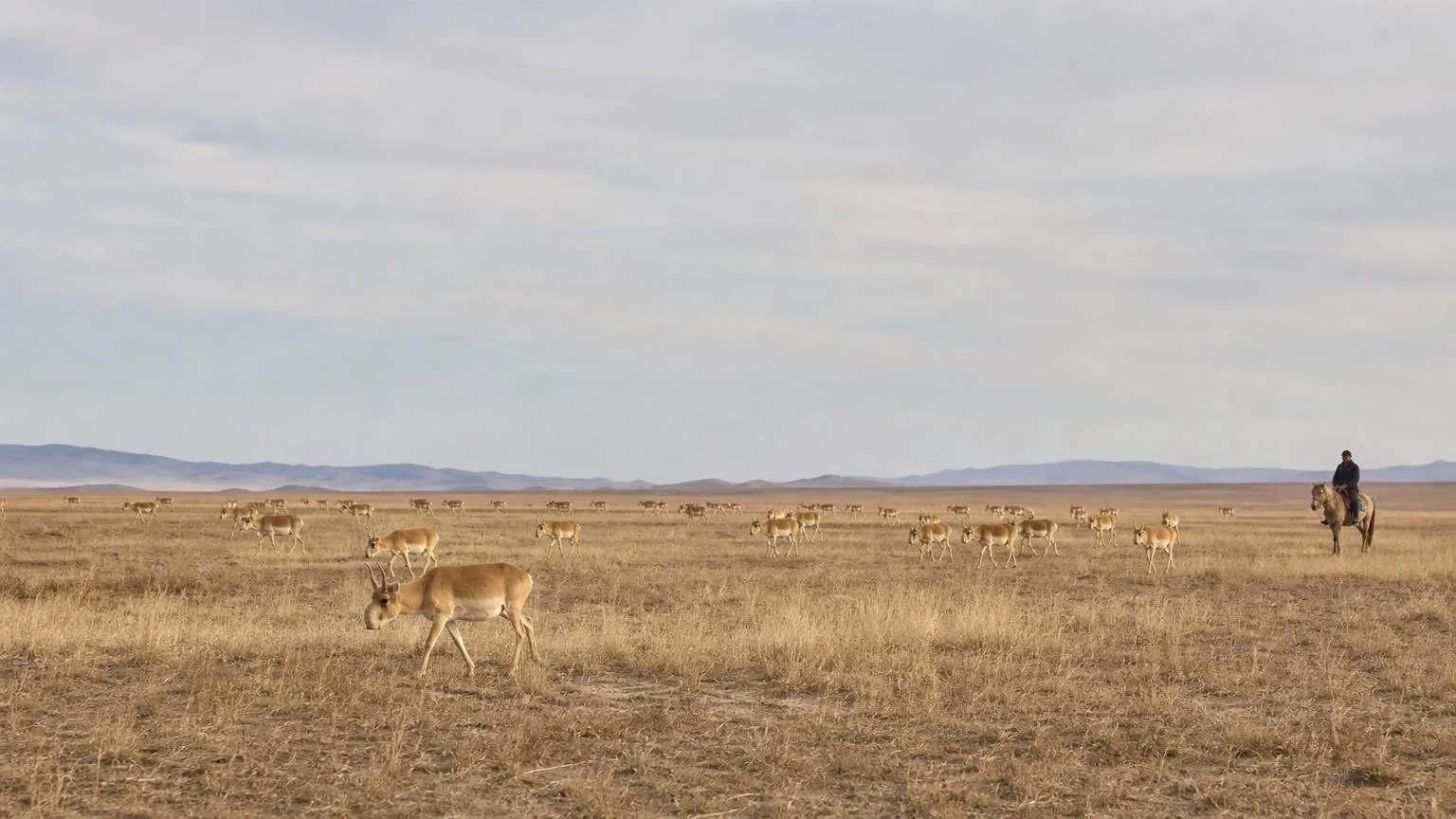
Within living memory the saiga has gone from one of the most numerous large mammals on earth to a species reduced by more than ninety per cent, and back again to a recovering population. That volatility is the defining feature of saiga conservation: numbers can move faster than policy can respond.
A century of change
How we got here
Four broad phases, rather than a year-by-year record — the detail changes by country, but the shape of it does not.
-
Early 1900s
Near collapse
Sustained hunting across the range reduces saiga numbers to a few thousand animals, and the species disappears entirely from large parts of its former range.
-
1950s–1980s
Soviet-era recovery
Strict hunting controls and a managed harvest allow numbers to recover to well over a million animals, in what remains one of the largest recoveries of any large mammal.
-
1990s
Post-Soviet collapse
The breakdown of state protection and a sharp rise in illegal hunting for horn cut the global population by more than ninety per cent within a decade.
-
2015
Mass mortality
A bacterial die-off removes a large share of one recovering population within weeks, a reminder that recovery is never secure on its own.
-
Recent years
A fragile recovery
Sustained protection, particularly of calving grounds, has allowed numbers to rise again — though the population remains concentrated, and concentrated populations remain vulnerable.
The numbers
Saiga population over time
Estimated global population, drawn from range-state survey data.
Population graph to be supplied
Pressures
The threats saigas face
Rarely one at a time. Most of the losses of the last century came from two or more of these arriving together.
Human-wildlife conflict
Saigas share the steppe with livestock and the people who depend on it. Where grazing, water and space are contested, wildlife is easily seen as a cost rather than an asset.
Poaching and illegal trade
Demand for horn continues to drive illegal hunting, and because only males carry horns it can skew the sex ratio of a population far beyond the number of animals killed.
Disease
Mass mortality events can remove a large share of a population within weeks. The triggers are still not fully understood, which makes prevention extremely difficult.
Climate and extreme weather
Severe winters and long droughts both hit saigas hard, and a changing climate is making the extremes that herds cannot walk away from more frequent.
Barriers to movement
Roads, railways, fencing and border infrastructure can cut herds off from the seasonal grazing and water they need, turning a long migration into a dead end.
Recovery is not the end of it
Saiga numbers are higher today than at any point since the collapse of the 1990s, and that is genuinely worth saying. But the population remains concentrated, the threats have not gone away, and this species has twice shown how quickly a good count can become a bad one. What holds a recovery in place is unglamorous and continuous: patrols through the calving season, monitoring that does not stop when the funding cycle does, and communities with a reason to want herds on their land.
You may also be interested in
Support our work
Keep them moving
Saiga herds cross hundreds of kilometres of open steppe every year. Your support helps keep those routes open, protected and safe.